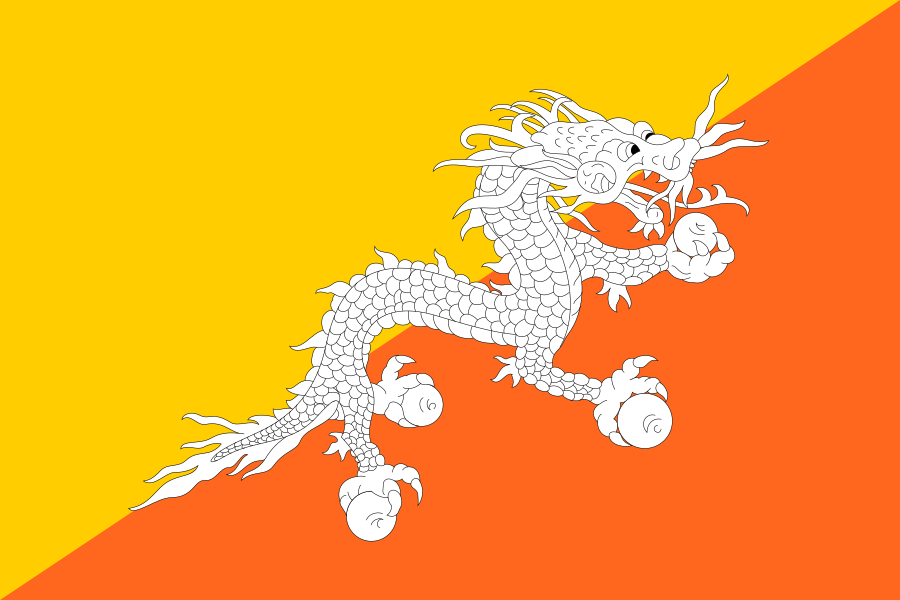
6 active areas of cooperation, as of July 2026. Click any card for the full brief.
01 SPECIAL RELATIONSHIP DEEP
Friendship Treaty and foundational architecture The India-Bhutan Friendship Treaty of 1949, signed two years after India's independence, codified a relationship that had been shaped by British India's absorption of Bhutan's foreign affairs and the unique position of the Himalayan kingdom as a buffer between India and Tibet (later China). The original treaty committed India to guide Bhutan's external relations and Bhutan to be guided by India's advice in foreign policy — a degree of Indian influence over a sovereign state that was without close parallel in modern international relations.
The treaty was comprehensively revised in February 2007, removing the clause that required Bhutan to be guided by India's advice on foreign policy and replacing it with language affirming that neither country shall allow its territory to be used against the other's security interests. The revision was a significant diplomatic upgrade for Bhutan, which joined the United Nations as a full member in 1971 and has progressively built bilateral relationships with countries outside the India-Bhutan-China triangle — though it still does not maintain diplomatic relations with the five permanent members of the UN Security Council.
The 2007 treaty retains the open-border provision, the free-trade arrangement, and the security partnership. It has been supplemented by approximately forty bilateral institutional mechanisms — joint technical committees, working groups, and commissions — spanning energy, trade, agriculture, infrastructure, education, health, and cultural exchange. No other bilateral relationship in India's neighbourhood is as densely institutionalised relative to the partner country's size.
FRIENDSHIP TREATY 2007 40+ MECHANISMS
Read brief → 02 HYDROPOWER DEEP
The electricity lifeline — Bhutan's largest export Hydropower is the centrepiece of Bhutan's economy and of the bilateral economic relationship. Bhutan's mountainous terrain gives it an estimated 30,000 MW of technically exploitable hydropower potential; of roughly 2,300 MW currently installed, nearly all is exported to India. Hydroelectricity is Bhutan's single largest export by far, and India is its sole electricity buyer, making the trade relationship structurally unique — one country purchasing the entirety of another's primary export.
India has financed the construction of Bhutan's major hydropower plants — including the flagship Tala (1,020 MW, commissioned 2006), Chukha (336 MW, the first large project commissioned in 1988), Kurichu (60 MW), Dagachhu (126 MW), and Mangdechhu (720 MW, commissioned 2019) — through grants and concessional loans. The model has been 60% debt (at highly concessional rates) and 40% grant for older plants, with recent projects tilted more toward the grant component. Power Purchase Agreements fix prices at rates negotiated bilaterally, and Bhutan's hydropower revenues have been the primary driver of Thimphu's GDP growth.
Future projects under development include the Punatsangchhu I (1,200 MW), Punatsangchhu II (1,020 MW), and Kholongchhu (600 MW) projects, with combined capacity that would substantially expand Bhutan's electricity export revenues. Punatsangchhu I has faced geological challenges and cost overruns that have tested the financing model, and both sides are renegotiating terms for the next generation of projects. A new hydropower development plan for the Twelfth Five-Year Plan (2023–2028) envisages joint-venture models — rather than the traditional grant-and-loan arrangement — as part of a broader effort to modernise the relationship's commercial architecture.
TALA MANGDECHHU
Read brief → 03 DEVELOPMENT AID DEEP
India — Bhutan's largest development partner India is by far Bhutan's largest source of official development assistance, having funded large parts of every Five-Year Plan since Bhutan launched its planned development process in 1961. India's contributions — taking the form of grants for current expenditure such as salaries of Indian teachers and medical personnel, project grants for infrastructure and social sectors, and project loans for hydropower — have typically covered 60–75% of Bhutan's plan outlay in earlier cycles, with the proportion declining as Bhutan's own revenues from hydropower have grown.
For Bhutan's Twelfth Five-Year Plan (2023–2028), India committed Rs 10,000 crore (approximately $1.2 billion) as the bilateral development grant, supplemented by separate project-specific financing. This places India's development assistance to Bhutan in a category comparable, relative to recipient GDP, to the aid provided by the United States or World Bank to major programme countries. The grant funds infrastructure (roads, bridges, schools, hospitals), technical assistance (Indian military training teams, teachers, doctors), and direct budget support for social sectors.
India's development footprint in Bhutan is institutionally embedded: Indian Border Roads Organisation (BRO) units have built and continue to maintain roads across Bhutan's strategic border areas, Indian Military Training Teams (IMTRATs) have trained the Royal Bhutan Army since 1961, and Indian teachers and medical officers have served in Bhutanese schools and hospitals for decades. The scale and depth of this developmental presence — in a country of under a million people — is without parallel in India's bilateral aid relationships.
RS 10,000 CR 12TH PLAN
Read brief → 04 SECURITY DEEP
Security partnership and the Doklam precedent The security dimension of India-Bhutan ties is the most strategically consequential aspect of the relationship. India provides Bhutan's external security guarantee implicitly through the 2007 Friendship Treaty's mutual non-use-of-territory clause, while Indian Military Training Teams (IMTRATs) stationed in Bhutan have trained and equipped the Royal Bhutan Army since independence. Bhutan does not have a formal defence treaty with India, and the precise contours of India's security commitments are deliberately kept vague — giving both sides flexibility — but the practical reality is that any significant external threat to Bhutan would trigger an Indian response.
The Doklam standoff of June–August 2017 illustrated the practical dimensions of this arrangement. Chinese road-construction activity in the Doklam plateau — disputed between Bhutan and China, but of direct strategic concern to India because of its proximity to the Siliguri Corridor (the narrow land bridge connecting Northeast India to the rest of the country) — prompted Indian troops to intervene at Bhutan's implicit request. The 73-day standoff between Indian and Chinese forces on Bhutanese territory ended with China halting construction, in what was widely read as a diplomatic and strategic success for India.
Doklam also revealed the complexities of Bhutan's position: Thimphu was careful not to publicly thank India for the intervention and has since accelerated its own bilateral border negotiations with China. The 2021 China-Bhutan MoU on a Three-Step Roadmap for the boundary settlement — concluded without prior consultation with India — and the 2023 Delimitation Agreement covering contested areas in both eastern and western sectors demonstrated that Bhutan is pursuing an independent path in managing its northern border, even as its southern security dependence on India remains unchanged.
DOKLAM 2017 IMTRAT
Read brief → 05 TRADE & CONNECTIVITY DEEP
Free trade, open border, and road connectivity India and Bhutan operate under a free-trade agreement that predates modern trade nomenclature: Bhutanese goods enter India duty-free, and Indian goods enter Bhutan duty-free, with the arrangement reflecting the open-border policy enshrined in the Friendship Treaty. India is Bhutan's overwhelmingly dominant trade partner — accounting for roughly 85% of Bhutan's total trade — and the trade relationship is structurally asymmetric: Bhutan's exports to India (dominated by hydroelectricity, ferro-silicon, calcium carbide, dolomite, and cement) are balanced against a wide range of Indian consumer goods, fuel, capital equipment, and food imports.
Road connectivity is vital to the trade relationship and to Bhutan's economic integration. India's Border Roads Organisation has built and maintains the primary road network connecting Bhutan's population centres to Indian border checkpoints at Phuentsholing, Gelephu, and Samdrup Jongkhar, and to Indian National Highway networks. The Gelephu Mindfulness City — a major new planned city and economic zone being developed near the India-Bhutan border in southern Bhutan — is designed to leverage India-Bhutan connectivity to attract investment and diversify Bhutan's economy beyond the highlands.
Bhutan's accession to the World Trade Organization is under consideration, and India has offered technical assistance for the accession process. The bilateral Free Trade Agreement is being reviewed to ensure it remains compatible with Bhutan's WTO membership obligations. Additionally, a rail link connecting Bhutan to India's Northeast Frontier Railway network — specifically a line from Hashimara to Phuentsholing — has been agreed in principle and is in the detailed planning stage, which would transform Bhutan's cargo logistics capacity when operational.
FREE TRADE BRO
Read brief → 06 PEOPLE-TO-PEOPLE DEEP
Open border, education, and cultural ties The India-Bhutan open border is perhaps the most distinctive feature of the relationship: citizens of both countries can travel across the border without passports or visas, simply using national identity documents. Bhutanese students — numbering in the thousands — attend Indian universities each year on ICCR scholarships and private arrangements, particularly in engineering, medicine, and management. The National Institute of Technology in Jalandhar, IIT Delhi, and Jawaharlal Nehru University have sizable Bhutanese student communities. India's Central Board of Secondary Education (CBSE) curriculum is followed in many Bhutanese schools, and English education in Bhutan has a strong India connection.
Cultural ties are rooted in shared Buddhist traditions — the Drukpa Kagyu school of Vajrayana Buddhism that predominates in Bhutan has deep connections to monastic lineages in India, particularly in Arunachal Pradesh (the site of Tawang monastery), Darjeeling, and Sikkim. The Bhutanese royal family has historically maintained warm personal ties with Indian leaders, and state visits by Bhutanese monarchs to India have a ceremonial warmth that goes beyond normal diplomatic protocol.
India's cultural diplomacy in Bhutan is also expressed through the physical footprint of Indian institutions: India funds schools, hospitals, and cultural centres in Bhutan. The Kharbandi Vocational Training Institute in Phuentsholing — built and funded by India — trains Bhutanese youth in trades aligned with Bhutan's development needs. The relationship at the people level is thus embedded in everyday life for many Bhutanese, not merely in the interactions of political elites.
OPEN BORDER ICCR
Read brief →